Welcome!
"You are visiting our Blog: Fast & Slow

You can get a fast search, but stay for
a slow and effective learning!"

Showing posts with label Technology. Show all posts

Sunday, 21 November 2010

Rapid prototyping

The speed of the new technologies of industrial production


Rapid prototyping is the automatic construction of physical objects using additive manufacturing technology. The first techniques for rapid prototyping became available in the late 1980s and were used to produce models and prototype parts. Today, they are used for a much wider range of applications and are even used to manufacture production-quality parts in relatively small numbers. Some sculptors use the technology to produce complex shapes for fine arts exhibitions.

Objects produced by rapid prototype process.

Patrick Jouin designed some solid stereolitography furniture a while ago. Stereolitography is a rapid prototyping technique and gaining popularity day by day.

Sunday, 14 November 2010

Ferrari World

The history of a "myth"


Ferrari World is a Ferrari themed amusement park on Yas Island in Abu Dhabi. The park is situated under a 200,000 square metres (2,200,000 sq ft) roof making it the largest indoor amusement park in the world. Ferrari World officially opened on November 4, 2010. The theme park is home to Formula Rossa the world's fastest roller coaster.

Yas Island, Abu Dhabi, United Arab Emirates.

Saturday, 13 November 2010

QWERTY and T9

Technological ways to speed up writing!


In computing, the keyboard is an input device of the computer application to manual data into computer memory and computer control.

"QWERTY" is the most common scheme for alphanumeric keyboards, used in most computer keyboards but also in the typewriters. The name "QWERTY" is derived from the sequence of the letters of the first six keys on the top row of the keyboard. The QWERTY layout was patented in 1864 by Christopher Sholes.
The scheme also attempts to split the QWERTY keys between the two hands, so that while one hand is placed, the other hand hits the button. This speeds up the writing than the methods previously used.


"QWERTY" keyboard is designed to typewriting faster using both hands alternately.
http://notebookitalia.it/tastiere-dei-notebook-al-microscopio-2218.html
Patent: http://www.freepatentsonline.com/7131780.pdf


T9, which stands for Text on 9 keys, is a patented predictive text technology for mobile phones, and it was invented to make easier and a lot faster typing text messages.
It allows words to be entered by a single keypress for each letter, as opposed to the multi-tap approach used in the older generation of mobile phones in which several letters are associated with each key, and selecting one letter often requires multiple keypresses.
As it gains familiarity with the words and phrases the user commonly uses, it speeds up the process by offering the most frequently used words first and then lets the user access other choices with one or more presses .

The T9 system allows to write a text message a lot faster than traditional systems.
http://www.gettyimages.it/Search/Search.aspx?contractUrl=2&language=it&family=creative&p=sms&assetType=image#
Patent: http://www.freepatentsonline.com/20070233463.pdf

Thursday, 11 November 2010

Tires for all your needs

So similar, so different

A tire is a ring-shaped covering that fits around a wheel rim to protect it and enable better vehicle performance by providing a flexible cushion that absorbs shock while keeping the wheel in close contact with the ground. The fundamental materials of modern tires are rubber and fabric along with other compound chemicals. Today, the vast majority of tires are pneumatic, comprising a doughnut-shaped body of cords and wires encased in rubber and generally filled with compressed air to form an inflatable cushion. Pneumatic tires are used on many types of vehicles, such as bicycles, motorcycles, cars, trucks, earthmovers, and aircraft.

What is important in the "Fast/Slow" context is that during years have developed a variety of different tires depending on which vehicles may be assembled, and consequently have different purposes and performance; for example, a tractor tire must be huge and partculary shaped in order to grasp on disconnected grounds, and so is designed for very slow speed:

A tractor tire is not designed to go fast, but to grasp on different grounds.
http://www.rotagri.com/


We can clearly see the differences with a racing tire, which is designed for reduce friction with the ground and so make the car run as fast as possible, with its slick shaped:


A racing tire is designed to go reduce the friction with the ground and as consequence to go fast.
http://www.slotbazar.com/product_info.php?manufacturers_id=26&products_id=819

Wednesday, 10 November 2010

Design in a fast-changing society

Sandbag lounge | Antenna Design


Flexibility. Design in a fast-changing society -Torino 2008 World Design Capital

Domestic sandbags by antenna design new york (masamichi udagawa & sigi moeslinger). http://www.cribcandy.com/ideas/dfb089f3368538e15476411540ffac6b&pageoffset=0

The installation spectre is inspired by a ubiquitous improvisational building block: the sandbag. The sandbag is a pervasive object used in various situations of emergency and temporary set-up, such as battlefields, floods, earthquakes and other disaster scenes. we are giving the sandbag a new skin and context, which transforms the way it is perceived allowing it to enter a different realm of existence.

Slow Design

What is slow design? Where did the idea come from? What does it consist of?


Theory

Slow design manifests itself in existing objects and spaces, in products and buildings, in real and virtual environments, and in socio-cultural experiences. Analysis of such manifestations suggests eight distinguishable themes although cross-over and hybridisation between these themes is also observed. These eight themes - ‘tradition’, ‘ritual’, ‘experiential’, ‘evolved’, ‘slowness’, ‘eco-efficiency’, ‘open source knowledge’ and ‘technology’ - contribute towards understanding the potential benefits of slow design towards individual, socio-cutural and environmental well-being. This framework provides a platform for further debate while offering a pluralistic, secular canvas for designers to encourage individual and socio-cultural change towards slowing metabolisms for a more sustainable future.

Some examples
Recycled materials, conservation and innovation of traditional knowledge, encourages recycling and auto design, socio-cultural memory, enhancement of the book lady, identity, humor, joy and colors in everyday life. 
http://blog.bientotdemain.com/index.php/tag/piece-unique
London-based design firm Raw Nerve's Slow Design sofa: "Above all it emphasizes slowness in the creation and consumption of products as a corrective to the frenetic pace of 21st-century life."
http://www.apartmenttherapy.com/ny/green-ideas/slow-design-nyt-house-home-roundup-13108-041690
 

Aerodynamics

How to exploit air flow


Aerodynamics is a branch of dynamics concerned with studying the motion of air, particularly when it interacts with a moving object. Understanding the motion of air (often called a flow field) around an object enables the calculation of forces and moments acting on the object. A typical propertie calculated for a flow field is speed.

Aerodynamic studies are applied in various disciplines, especially to design vehicles that have to be very fast, such as airplanes, rockets, racing cars but also "ordinary" cars: since aerodynamic, a car reduces the resistance of air and, as a consequence, consumes less fuel.


Air flow around three objects: spherical bodies are subject to an average resistance, the shape of an airplane wing minimizes the air resistance, and the resistance is high for bodies with large surfaces perpendicular to the flow.
http://dida.fauser.edu/aero/terza/alainfin/resisten.htm

In racing cars aerodynamics plays a very important role; mechanicians study very carefully how to design the perfect shape to let the driver go faster.
http://www.f1fanatic.co.uk/wallpapers/pictures-of-f1-cars/bar-005-2003-f1-car-pictures/bar_cfd_2003_2/

The pneumatic tube

In postal service


Pneumatic post or pneumatic mail is a system to deliver letters through pressurized air tubes. It was invented by the Scottish engineer William Murdoch in the 19th century and was later developed by the London Pneumatic Dispatch Company. Pneumatic post systems were used in several large cities starting in the second half of the 19th century (including an 1866 London system powerful and large enough to transport humans during trial runs - though not intended for the purpose), but were largely abandoned during the 20th century.


Pneumatic tubes in use at a drive-through bank.
Patent: http://www.freepatentsonline.com/6474912.pdf

Pneumatic post stations usually connected post offices, stock exchanges, banks and ministries. Italy was the only country to issue postage stamps (between 1913 and 1966) specifically for pneumatic post. Austria, France, and Germany issued postal stationery for pneumatic use.

Spirit of Saint Louis US airmail stamp of 1927.

In the American animated science fiction sitcom Futurama this system is usually used to deliver letters:


Sunday, 7 November 2010

The rallenty effect

Let's watch it again in slow motion!

The instant replay is the replaying of video footage of an event or incident very soon after it has occurred.
In television broadcasting of sports events, instant replay is often used during live broadcast, to show a passage of play which was important or remarkable, or which was unclear on first sight. Replays are typically shown during a break.

The replay may be in slow motion, or from multiple camera angles. More advanced technology has allowed for more complex replays, such as freeze frame, frame-by-frame review, and overlaying of virtual graphics. Sports commentators analyze the replay footage when it is being played, rather than describing the concurrent live action.


In Italy the istant replay is often used during and after football matches, and it is often reason of quarrels.

Wednesday, 3 November 2010

TAV

How to shorten the distance


High-speed rail


High-speed rail(HSR) is a type of passenger rail transport that operates significantly faster than the normal speed of rail traffic. Specific definitions by the European Union include 200 km/h (120 mph) for upgraded track and 250 km/h (160 mph) or faster for new track. In Japan, Shinkansen lines run at speeds in excess of 260 km/h (160 mph) and are built using standard gauge track with no at-grade crossings. In China, high-speed conventional rail lines operate at top speeds of 350 km/h (220 mph),and one Maglev Line in Shanghai reaches speeds of 431 km/h (268 mph). The world record for conventional high-speed rail is held by the V150, a specially configured version of Alstom's TGV which clocked 574.8 km/h (357.2 mph) on a test run. The world speed record for Maglev is held by the japanese experimental MLX01: 581 km/h (361 mph).

While high-speed rail is usually designed for passenger travel, some high-speed systems also carry some kind of freight service. For instance, the French mail service La Poste owns a few special TGV trains for carrying postal freight.

TAV

High-speed Railroad Map Europe 2009


Tissues' accessories

Open and close quickly and easily


Zipper
 
A zipper (British English: zip or (rarely) zip fastener) is a popular device for temporarily joining two edges of fabric. It is used in clothing (e.g., jackets and jeans), luggage and other bags, sporting goods, camping gear (e.g., tents and sleeping bags), and other daily use items.
Drawstring

A drawstring (or draw string or draw-string) is a string, cord, or rope used (when pulled) to "draw" (tighten) or tie an opening in fabric closed/shut.

Drawstring
Patent: http://www.freepatentsonline.com/3744105.pdf


How long it takes to button your shirt?

A very slow "operation"!

Tuesday, 2 November 2010

In Medicine, what does FAST stand for?

"Fast" as acronym


FAST is an acronym for quickly remembering the symptoms of a stroke. It is more frequently used in Australia, than in the United States, but a 2007 episode of the medical drama House featured the concept. It’s an excellent acronym to remember because early treatment of stroke is essential to reducing brain damage and mortality associated with stroke.

FAST is a fairly loose acronym, and the letters only correlate to a few symptoms of stroke. These are facial paralysis, arm weakness, and speech difficulties. The “T” in FAST is often translated as “time to act fast.” Others interpret the “T” as “test all symptoms.” The first interpretation is used by the Stroke Foundation of Australia, and for most laypeople, it’s probably best to remember the first definition. It is definitely essential to act quickly by contacting emergency services if a stroke is suspected.


http://www.wisegeek.com/in-medicine-what-does-fast-stand-for.htm
http://freeliberal.com/archives/001179.php

Speed of Light

Faster than light!?

The speed of light in a vacuum is presently defined to be exactly 299,792,458 m/s (approximately 186,282 miles per second). The fixed value of the speed of light in SI units results from the fact that the metre is now defined in terms of the speed of light.

Different physicists have attempted to measure the speed of light throughout history.

Machines do it faster!

Manual tasks become mechanical works


Combine pieces of cloth or other material, using needle and thread, has always been a slow manual work, that asks lot of care and skills; nowadays in factories and often in our houses we use the sewing machine, a mechanical instrument invented in 1790; from the early hand-operating models, technological evolution has produced foot pedal sewing machines, and finally with an electric motor within.
Sewing has therefore become much faster, no longer requiring ability.

The sewing machine has so changed this world that hand sewing has become an hobby.

This argument can be extended beyond the borders of sewing, infact it concernes any work that technological evoltion changed from manual to be done with machines.

Hand sewing in a very slow work, requiring time and ability.
http://www.gettyimages.it/detail/85210070/Digital-Vision
The sewing machine made this work a lot faster and simple.
http://www.gettyimages.it/detail/78325162/Brand-X-Pictures

Photographic Techique

How to capture the movement 

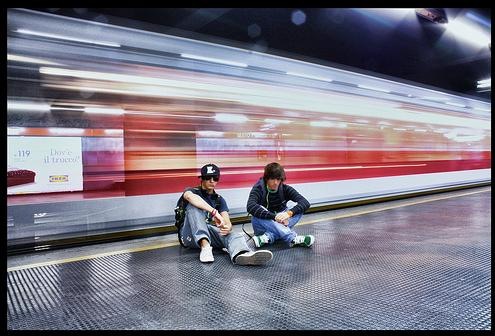
The panning technique is used to suggest fast motion, and bring out the subject from other elements in the frame. In photographic pictures it is usually noted by a foreground subject in action appearing still (i.e. a runner frozen in mid-stride) while the background is streaked and/or skewed in the apparently opposite direction of the subject's travel.

Subject in focus and blurred background.

Blurred subject and background in focus.

http://gerasimone.altervista.org/2007/fotografare-il-movimento/
http://www.fotografia-digitale.info/tecniche/560/catturare-leffetto-movimento-in-fotografia/

Cinematographic Techniques

Slow down fastness, speed up slowness!

Fast Forward: to fast-forward means to move forward through an audio or video recording at a speed faster than that at which it would usually flow.

Slow Motion: is an effect in film-making whereby time appears to be slowed down. It was invented by August Musger.
Slow motion is ubiquitous in modern filmmaking. It is used by a diverse range of directors directors to achieve diverse effects. Some classic subjects of slow motion include:
  • Athletic activities of all kinds, to demonstrate skill and style.
  • To recapture a key moment in an athletic game, typically shown as a replay.
  • Natural phenomena, such as a drop of water hitting a glass.

Thursday, 28 October 2010

Digital people: “fast”, “slow” or “out”?

Italians, nation of poets, saints and...navigators?


The Italian population who daily use Internet, is estimated at about twenty million. According to reliable statistics, the Italians who have a broadband connection are at least 12% of the population. Depending on the type of connection used, you can then identify three "categories" of people:

-“fast”;
-”slow”;
-“out”;

Fast” are people updated at the modern world, using the Internet as an extension of their cognitive and social skills, tend to be "always connected" to the ADSL or optical fiber at home and at work, UMTS and Wi-Fi when they are on the road. "

http://www.comuniclab.it/42479/internet-40-anni-dopo


Slow” are those who, by choice or by lack of alternatives, still use the analog connection to 56 kbps or ISDN, useful for downloading your mail (without attachments if possible) and some occasional browsing, not for work online. The phone for them is still an instrument to talk and, occasionally, send sms.

http://dixdipcpervoi.blogspot.com/2010/09/internet-in-italia-va-piu-lento-che-in.html

The category "out", which still includes the majority of Italians, well represents the general situation of Italy, a nation struggling to keep pace with the modern times. The "out" see the Net as a strange animal, preferably to be kept in a cage.

Unfortunately, until the "out" are the majority in the politicians and can handle the power, we will be hardly able to enjoy the great opportunities that the digital revolution offers. We will be a nation of users but we will never be able to innovate.